How to Do a Guided Close Reading
Utilise the guidelines below to larn near the practice of shut reading.
Overview
When your teachers or professors enquire you to analyze a literary text, they ofttimes look for something frequently chosen close reading. Shut reading is deep analysis of how a literary text works; it is both a reading process and something you include in a literary analysis paper, though in a refined class.
Fiction writers and poets build texts out of many central components, including subject field, form, and specific word choices. Literary assay involves examining these components, which allows the states to discover in small parts of the text clues to help us understand the whole. For example, if an writer writes a novel in the form of a personal journal well-nigh a grapheme'southward daily life, but that journal reads like a serial of lab reports, what exercise we learn about that grapheme? What is the issue of picking a word similar "tome" instead of "book"? In consequence, you lot are putting the author'south choices nether a microscope.
The process of close reading should produce a lot of questions. It is when yous begin to answer these questions that you are ready to participate thoughtfully in class discussion or write a literary analysis paper that makes the about of your close reading piece of work.
Close reading sometimes feels like over-analyzing, but don't worry. Close reading is a procedure of finding as much data as you tin can in order to class every bit many questions every bit y'all can. When it is time to write your paper and formalize your shut reading, you lot will sort through your work to figure out what is most disarming and helpful to the argument you hope to make and, conversely, what seems like a stretch. This guide imagines you are sitting downwardly to read a text for the first time on your mode to developing an argument about a text and writing a paper. To give ane example of how to do this, we will read the poem "Design" by famous American poet Robert Frost and attend to iv major components of literary texts: subject, form, word option (wording), and theme.
If you want fifty-fifty more information about budgeted poems specifically, have a await at our guide: How to Read a Poem.
The Verse form
As our guide to reading verse suggests, have a pencil out when you read a text. Make notes in the margins, underline important words, place question marks where you are confused by something. Of grade, if yous are reading in a library book, you should keep all your notes on a separate piece of paper. If y'all are not making marks straight on, in, and beside the text, be sure to note line numbers or even quote portions of the text and so you have enough context to call back what you found interesting.
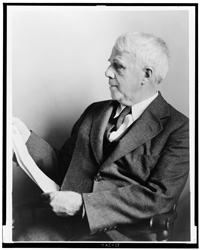
Design
I institute a dimpled spider, fatty and white,
On a white heal-all, belongings up a moth
Similar a white piece of rigid satin cloth—
Assorted characters of decease and bane
Mixed ready to begin the morning correct,
Like the ingredients of a witches' broth—
A snow-drop spider, a flower similar a barm,
And dead wings carried like a paper kite.
What had that bloom to exercise with being white,
The wayside blue and innocent heal-all?
What brought the kindred spider to that summit,
So steered the white moth thither in the nighttime?
What but pattern of darkness to appall?—
If design govern in a thing so small.
Subject
The bailiwick of a literary text is simply what the text is about. What is its plot? What is its most important topic? What image does it describe? It'south like shooting fish in a barrel to retrieve of novels and stories as having plots, only sometimes it helps to remember of poetry as having a kind of plot besides. When y'all examine the subject area of a text, y'all want to develop some preliminary ideas most the text and brand certain you understand its major concerns before you dig deeper.
Observations
In "Pattern," the speaker describes a scene: a white spider property a moth on a white flower. The flower is a heal-all, the blooms of which are usually violet-blue. This heal-all is unusual. The speaker then poses a serial of questions, asking why this heal-all is white instead of blue and how the spider and moth found this particular flower. How did this situation arise?
Questions
The speaker's questions seem simple, but they are really adequately nuanced. We can utilise them every bit a guide for our own as we become forward with our close reading.
- Furthering the speaker's simple "how did this happen," we might ask, is the scene in this poem a manufactured state of affairs?
- The white moth and white spider each utilise the atypical white flower as camouflage in search of sanctuary and supper respectively. Did these flora and fauna come together for a purpose?
- Does the speaker have a opinion almost whether there is a purpose behind the scene? If so, what is it?
- How volition other elements of the text chronicle to the unpleasantness and uncertainty in our get-go look at the poem's discipline?
Later thinking about local questions, we have to zoom out. Ultimately, what is this text about?
Form
Form is how a text is put together. When you look at a text, find how the writer has arranged information technology. If it is a novel, is it written in the commencement person? How is the novel divided? If information technology is a brusk story, why did the writer choose to write short-class fiction instead of a novel or novella? Examining the form of a text can help you lot develop a starting set of questions in your reading, which then may guide farther questions stemming from fifty-fifty closer attention to the specific words the writer chooses. A little background inquiry on form and what different forms can mean makes information technology easier to figure out why and how the author's choices are important.
Observations
Virtually poems follow rules or principles of form; even free verse poems are marked by the author'south choices in line breaks, rhythm, and rhyme—even if none of these exists, which is a notable pick in itself. Hither's an case of thinking through these elements in "Blueprint."
In "Design," Frost chooses an Italian (or Petrarchan) sonnet form: 14 lines in iambic pentameter consisting of an octave (a stanza of 8 lines) and a sestet (a stanza of vi lines). We will focus on rhyme scheme and stanza structure rather than meter for the purposes of this guide. A typical Italian sonnet has a specific rhyme scheme for the octave:
a b b a a b b a
There's more variation in the sestet rhymes, but one of the more mutual schemes is
c d e c d due east
Conventionally, the octave introduces a problem or question which the sestet then resolves. The point at which the sonnet goes from the problem/question to the resolution is called the volta, or plough. (Annotation that we are speaking but in generalities here; in that location is a bang-up deal of variation.)
Frost uses the usual octave scheme with "-ite"/"-ight" (a) and "oth" (b) sounds: "white," "moth," "cloth," "blight," "correct," "broth," "froth," "kite." However, his sestet follows an unusual scheme with "-ite"/"-ight" and "all" sounds:
a c a a c c
Questions
At present, we have a few questions with which we can beginning:
- Why use an Italian sonnet?
- Why use an unusual scheme in the sestet?
- What problem/question and resolution (if whatsoever) does Frost offer?
- What is the volta in this poem?
- In other words, what is the bespeak?
Italian sonnets have a long tradition; many careful readers recognize the form and know what to expect from his octave, volta, and sestet. Frost seems to do something fairly standard in the octave in presenting a situation; even so, the turn Frost makes is not to resolution, but to questions and uncertainty. A white spider sitting on a white blossom has killed a white moth.
- How did these elements come together?
- Was the moth'south expiry random or by blueprint?
- Is 1 worse than the other?
We can approximate right away that Frost'due south disruption of the usual purpose of the sestet has something to do with his disruption of its rhyme scheme. Looking fifty-fifty more than closely at the text will aid the states refine our observations and guesses.
Discussion Choice, or Diction
Looking at the word choice of a text helps us "dig in" ever more securely. If you are reading something longer, are there certain words that come again and once more? Are there words that stand out? While you are going through this process, it is all-time for you to assume that every word is important—again, you can determine whether something is actually important later.
Even when you read prose, our guide for reading poetry offers adept advice: read with a pencil and make notes. Marking the words that stand up out, and perhaps write the questions you have in the margins or on a separate piece of paper. If you have ideas that may possibly reply your questions, write those downward, too.
Observations
Let's have a wait at the first line of "Design":
I found a dimpled spider, fat and white
The poem starts with something unpleasant: a spider. Then, equally nosotros wait more closely at the adjectives describing the spider, we may encounter connotations of something that sounds unhealthy or unnatural. When we imagine spiders, we practise non generally picture them dimpled and white; it is an uncommon and incomparably creepy epitome. There is noise betwixt the spider and its descriptors, i.east., what is incorrect with this picture? Already nosotros have a question: what is going on with this spider?
We should look for additional clues further on in the text. The next ii lines develop the epitome of the unusual, unpleasant-sounding spider:
On a white heal-all, holding upwardly a moth
Similar a white slice of rigid satin material—
Now we have a white flower (a heal-all, which usually has a violet-blueish bloom) and a white moth in addition to our white spider. Heal-alls have medicinal properties, as their proper noun suggests, merely this ane seems to have a genetic mutation—mayhap like the spider? Does the mutation that changes the heal-all's color also change its beneficial properties—could it be poisonous rather than curative? A white moth doesn't seem remarkable, but information technology is "Like a white piece of rigid satin fabric," or like manmade fabric that is artificially "rigid" rather than smooth and flowing like we imagine satin to exist. We might think for a moment of a shroud or the lining of a bury, but even that is amiss, for neither should be strong with death.
Questions
The commencement three lines of the poem's octave introduce unpleasant natural images "of death and blight" (as the speaker puts it in line four). The flower and moth disrupt expectations: the heal-all is white instead of "bluish and innocent," and the moth is reduced to "rigid satin cloth" or "expressionless wings carried similar a paper kite." We might expect a spider to exist unpleasant and deadly; the poem'south spider also has an unusual and unhealthy appearance.
- The focus on whiteness in these lines has more to do with death than purity—can we empathize that whiteness as being corpse-like rather than virtuous?
Well before the volta, Frost makes a "turn" abroad from nature equally a retreat and haven; instead, he unearths its inherent dangers, making nature menacing. From three lines lone, we have a number of questions:
- Will whiteness play a role in the rest of the poem?
- How does "design"—an organisation of these circumstances—fit with a scene of death?
- What other juxtapositions might we meet?
These disruptions and dissonances recall Frost's alteration to the standard Italian sonnet form: finding the means and places in which form and word option go together will assistance us begin to unravel some larger concepts the poem itself addresses.
Theme
Put merely, themes are major ideas in a text. Many texts, specially longer forms like novels and plays, have multiple themes. That's good news when yous are close reading because it means there are many dissimilar means you can think through the questions you develop.
Observations
And then far in our reading of "Pattern," our questions revolve around disruption: disruption of grade, disruption of expectations in the description of sure images. Discovering a concept or idea that links multiple questions or observations yous accept made is the commencement of a discovery of theme.
Questions
What is happening with disruption in "Design"? What point is Frost making? Observations nearly other elements in the text assistance you address the idea of disruption in more depth. Here is where nosotros look back at the work we take already done: What is the text nigh? What is notable about the form, and how does it back up or undermine what the words say? Does the specific language of the text highlight, or redirect, sure ideas?
In this case, nosotros are looking to determine what kind(southward) of disruption the verse form contains or describes. Rather than "disruption," we want to see what kind of disruption, or whether indeed Frost uses disruptions in form and linguistic communication to communicate something opposite: blueprint.
Sample Analysis
Subsequently you make notes, codify questions, and set up tentative hypotheses, you must analyze the subject of your close reading. Literary analysis is some other procedure of reading (and writing!) that allows you lot to make a claim almost the text. Information technology is also the point at which you plough a disquisitional centre to your before questions and observations to notice the most compelling points, discarding the ones that are a "stretch." Past "stretch," nosotros mean that we must discard points that are fascinating but have no clear connection to the text as a whole. (Nosotros recommend a split document for recording the bright ideas that don't quite fit this time effectually.)
Here follows an excerpt from a brief analysis of "Pattern" based on the close reading above. This example focuses on some lines in smashing detail in order to unpack the significant and significance of the poem's language. Past commenting on the dissimilar elements of shut reading we have discussed, it takes the results of our close reading to offer i particular way into the text. (In instance you were thinking about using this sample as your ain, be warned: it has no thesis and it is easily discoverable on the spider web. Plus it doesn't take a title.)
Excerpt
Frost's speaker brews unlikely associations in the showtime stanza of the poem. The "Assorted characters of expiry and blight / Mixed set up to begin the morning time right" make of the grotesque scene an equally grotesque mockery of a breakfast cereal (4–5). These lines are virtually singsong in meter and it is easy to imagine them prepare to a radio jingle. A pun on "correct"/"rite" slides the "characters of expiry and blight" into their expected concoction: a "witches' broth" (6). These juxtapositions—a healthy breakfast that is too a potion for dark magic—are borne out when our "fat and white" spider becomes "a snow-driblet"—an early on spring flower associated with renewal—and the moth as "dead wings carried like a paper kite" (one, seven, viii). Like the mutant heal-all that hosts the moth's death, the spider becomes a deadly bloom; the harmless moth becomes a kid's toy, but every bit "dead wings," more than similar a puppet made of a skull.
The volta offers no resolution for our unsettled expectations. Having observed the scene and detailed its elements in all their unpleasantness, the speaker turns to questions rather than answers. How did "The wayside blue and innocent heal-all" end upwardly white and bleached like a bone (x)? How did its "kindred spider" detect the white flower, which was its perfect hiding identify (11)? Was the moth, then, also searching for camouflage, simply to run into its terminate?
Using another question as a disguise, the speaker offers a hypothesis: "What but blueprint of darkness to appall?" (13). This question sounds rhetorical, as though the only reason for such an unlikely combination of flora and animal is some "design of darkness." Some force, the speaker suggests, assembled the white spider, bloom, and moth to snuff out the moth's life. Such a pattern appalls, or horrifies. We might also consider the speaker asking what other force but dark design could utilise something as elementary as appalling in its other sense (making pale or white) to issue decease.
Still, the poem does not shut with a question, but with a argument. The speaker's "If pattern govern in a thing and then small" establishes a condition for the octave's questions after the fact (14). In that location is no point in considering the dark design that brought together "assorted characters of death and blight" if such an event is besides minor, also physically pocket-size to be the work of some forcefulness unknown. Catastrophe on an "if" clause has the result of rendering the poem still more uncertain in its conclusions: not only are we faced with unanswered questions, nosotros are at present non even certain those questions are valid in the outset identify.
Behind the speaker and the agonizing scene, we have Frost and his defiance of our expectations for a Petrarchan sonnet. Like whatever designer may accept altered the bloom and attracted the spider to kill the moth, the poet built his verse form "wrong" with a purpose in mind. Blueprint surely governs in a poem, yet small; does Frost also have a nighttime design? Tin can we compare a scene in nature to a carefully synthetic sonnet?
A Note on Organization
Your goal in a newspaper well-nigh literature is to communicate your best and most interesting ideas to your reader. Depending on the type of paper you have been assigned, your ideas may demand to be organized in service of a thesis to which everything should link back. It is all-time to enquire your instructor nearly the expectations for your paper.
Knowing how to organize these papers can be tricky, in office because there is no single correct answer—only more than and less constructive answers. You may decide to organize your paper thematically, or past tackling each idea sequentially; you may cull to order your ideas past their importance to your argument or to the poem. If you are comparing and contrasting two texts, you might work thematically or by addressing kickoff 1 text and then the other. One way to approach a text may be to outset with the beginning of the novel, story, play, or poem, and work your manner toward its cease. For case, hither is the crude construction of the instance in a higher place: The author of the sample decided to use the poem itself every bit an organizational guide, at least for this part of the assay.
- A paragraph virtually the octave.
- A paragraph virtually the volta.
- A paragraph most the penultimate line (13).
- A paragraph near the last line (xiv).
- A paragraph addressing form that suggests a transition to the next section of the newspaper.
You will accept to decide for yourself the best way to communicate your ideas to your reader. Is it easier to follow your points when you write about each part of the text in particular earlier moving on? Or is your work clearer when you work through each big idea—the significance of whiteness, the effect of an altered sonnet form, and and so on—sequentially?
We advise you write your paper however is easiest for you lot then motion things around during revision if y'all demand to.
Further Reading
If yous really want to master the practice of reading and writing nearly literature, nosotros recommend Sylvan Barnet and William East. Cain'due south wonderful book, A Short Guide to Writing most Literature. Barnet and Cain offering non only definitions and descriptions of processes, but examples of explications and analyses, equally well equally checklists for you lot, the writer of the paper. The Short Guide is certainly not the simply available reference for writing virtually literature, simply it is an splendid guide and reminder for new writers and veterans alike.
Source: https://writing.wisc.edu/handbook/assignments/closereading/
0 Response to "How to Do a Guided Close Reading"
Post a Comment